Whether popular stories of the Big Bang's first instant survive today's data depends on what else we let vary. The next generation of telescopes could remove that ambiguity.
Ruling things out in cosmology has an uncomfortable feature: the verdict depends on what you assume you already know.
Every structure in the universe, from galaxies and clusters to us, grew from tiny differences in density that existed at the very beginning. The cosmic microwave background, the oldest light we can see, preserves a record of them. Their statistical recipe is called the primordial power spectrum. It tells us how strong those early variations were at each physical scale. To a good approximation, it follows a simple power law with two key properties. The tilt, ns, sits just below 1, which means the fluctuations are slightly stronger on larger scales. The running, αs, asks whether that tilt itself drifts with scale.
These two numbers matter because rival accounts of the first instant predict them. Starobinsky inflation, axion monodromy, holographic cosmologies, Quantum Quadratic Gravity and the Bi-thermal Big Bang each land somewhere between ns ≈ 0.96 and 0.983, with αs close to zero. Measuring the two numbers precisely is a way of cross-examining theories of the Big Bang itself.
A verdict that depends on the fine print
In a new preprint with Zachary Cheslog, Emily Finson, Amanda MacInnis, Neelima Sehgal, Simran K. Nerval and Renée Hložek, we combined microwave-background data from Planck, ACT and SPT (together, CMB-PAS) with the latest galaxy-distance measurements from DESI DR2. In a more restrictive fit, where certain neutrino-sector quantities are held at their standard values, two models are disfavored at roughly 95% confidence. One is Starobinsky inflation. The other is the Bi-thermal Big Bang, which João Magueijo and I proposed.
That would make a tidy headline, but it would lean on the fine print. Neutrinos are already part of standard cosmology. The restrictive fit, however, fixes two quantities in the light-particle sector: the effective abundance of light relics, Neff, and the sum of the neutrino masses, Σmν. Both leave imprints on the microwave sky that can partly mimic a change in tilt. There are good reasons to let them vary. Additional light relics contributing to the radiation density could shift Neff away from its standard value. The data's own upper limit on the mass sum, below 0.056 eV at 95% confidence, already sits in mild tension with neutrino-oscillation experiments.
When we free both quantities, the extended nine-parameter fit gives ns = 0.9758 ± 0.0064 and αs = 0.0080 ± 0.0064. The running has a slightly positive central value but remains consistent with zero; there is no detection of nonzero running. Starobinsky inflation and the Bi-thermal model both fall back within the allowed region. This does not exonerate them, and it is not a preference for them. It means neither is excluded in this extended fit once those neutrino-sector quantities are left free.
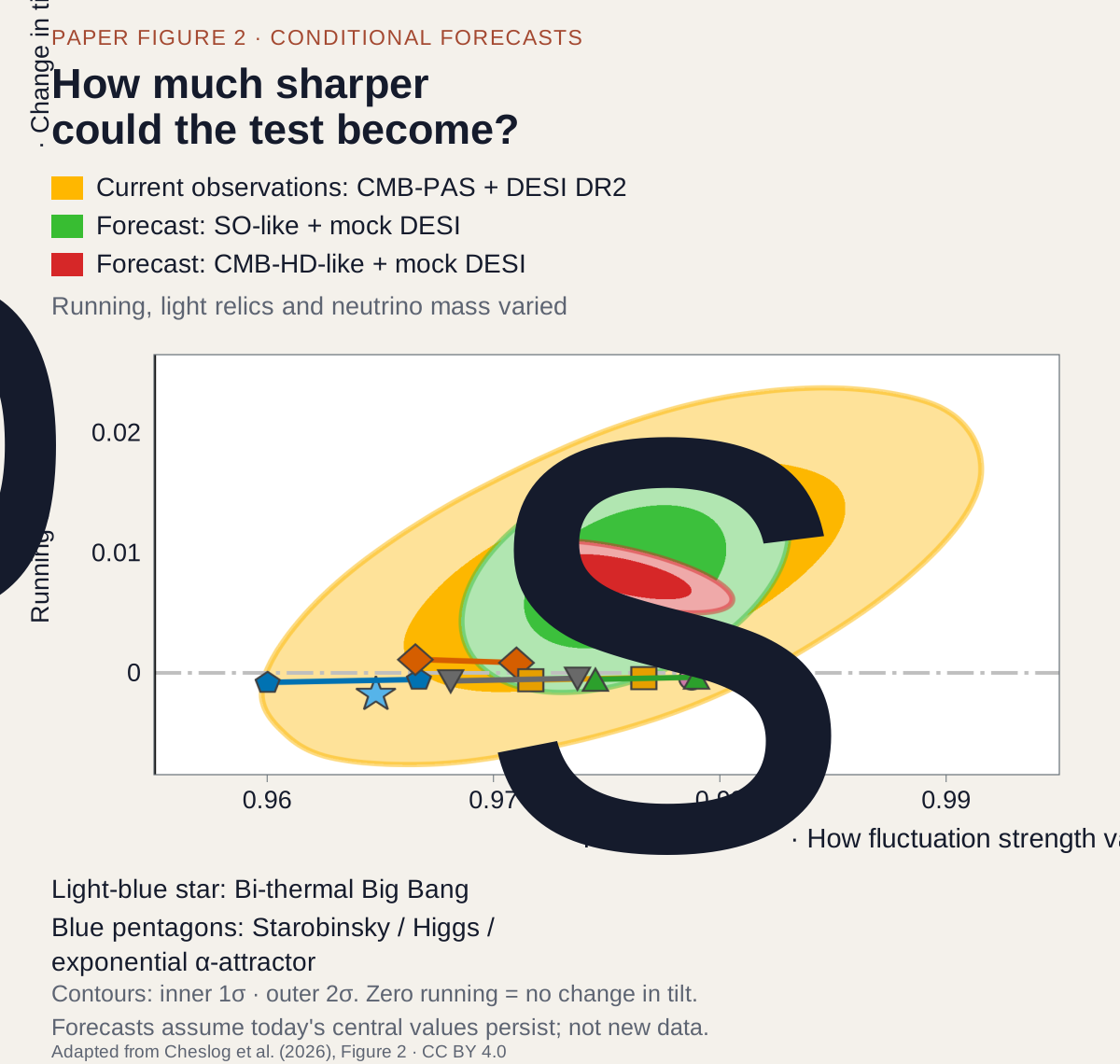
Which theories do the markers represent?
Light-blue star: Bi-thermal Big Bang. Blue pentagons: Starobinsky/Higgs inflation and exponential α-attractor. Pink circle: SUSY GUTS. Green upward triangles: axion monodromy/monomial inflation with power 2/5. Gray downward triangles: polynomial α-attractor with κ = 2. Gold squares: quantum quadratic gravity. Orange diamonds: renormalizable holographic cosmology. Inflationary ranges use N* = 47–57 e-folds where applicable, as in the paper.
Quantum Quadratic Gravity is also in Figure 2, marked by squares. It connects directly to Where Could Inflation Begin?, my recent essay on work with Ruolin Liu. There we asked how the quantum running of gravity could supply a starting point for inflation. Here, its predictions face the same tilt-and-running test as the other models.
What sharper eyes could do
The degeneracy need not remain this strong. We forecast what an SO-like and a CMB-HD-like survey, each combined with mock DESI distance data, could achieve. Both could substantially untangle Neff from the tilt. The forecasts are centered on today's marginalized mean values. If those central values persist, an SO-like survey could exclude the Bi-thermal and Starobinsky models at about 3σ. A CMB-HD-like survey could exclude every early-universe model we considered by at least 6σ, including the one I helped propose. That is the point of making a sharp prediction.
The "if" carries real weight. Central values move as data improve. These forecasts measure how finely an instrument could resolve the question. They do not tell us which answer it will find.
Beyond two numbers
The tilt and running compress the spectrum into a couple of numbers. We can also ask about its full shape. For Figure 3, we drop the power-law assumption and fit the spectrum's amplitude in independent bins of wavenumber, together with four other standard cosmological parameters. This is a separate analysis from the nine-parameter fit above, and it is not model-free. Because the amplitude is entangled with the optical depth to reionization, τ, the quantity actually measured is e−2τP(k).
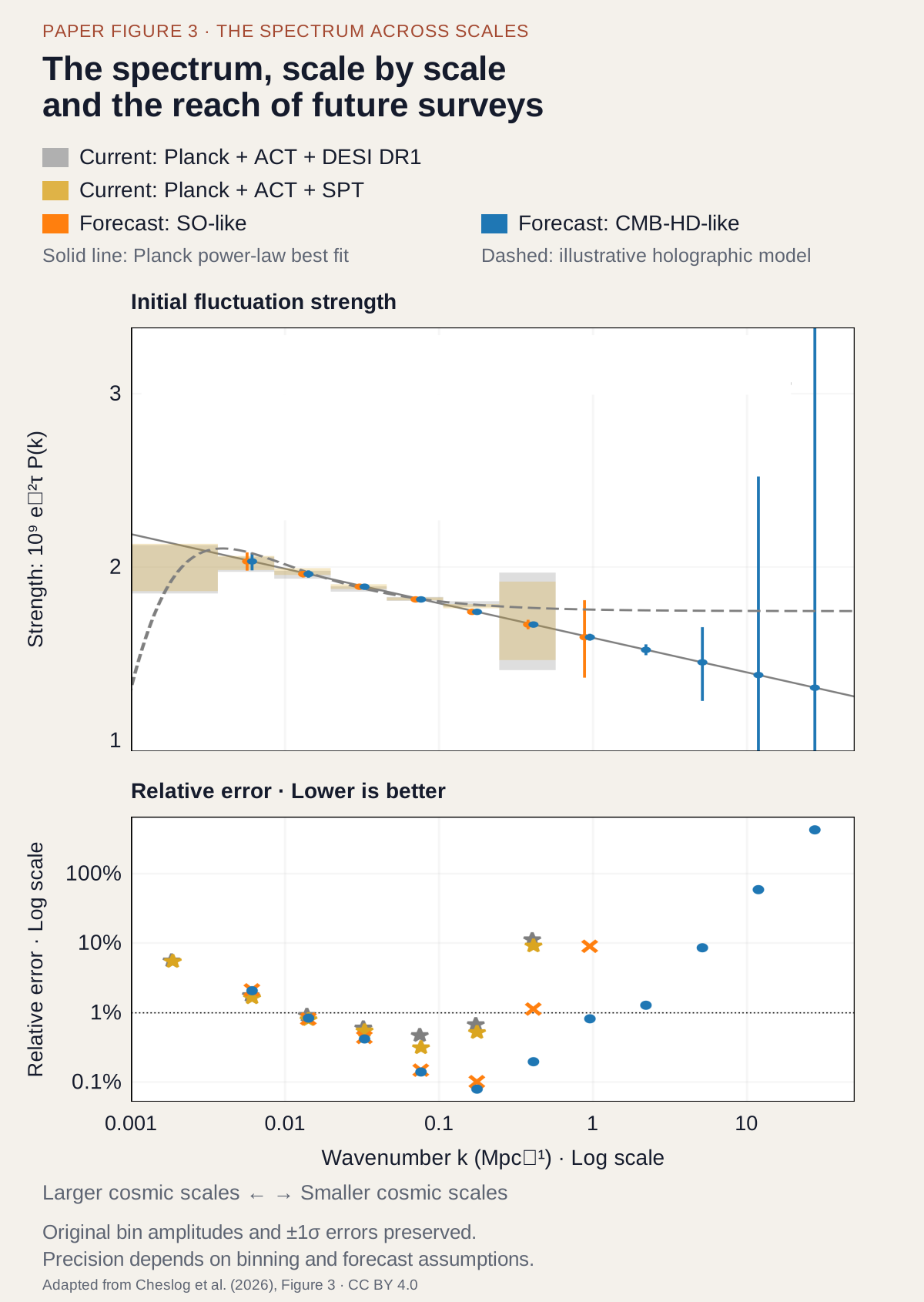
In the upper panel, the current bins sit comfortably on a simple power law. The dashed curve shows a non-power-law alternative, a super-renormalizable holographic spectrum that flattens on small scales. It is drawn to illustrate the kind of shape future data could test, not as something detected or favored. The lower panel shows the uncertainties, which are where the progress lies. Near k ≈ 0.2 Mpc−1, current CMB-PAS data pin the weighted spectrum to about 0.5% in our seven-bin scheme, and both forecast surveys reach about 0.1%. These numbers depend on the binning, and finer bins give larger errors per bin. Higher wavenumber means smaller physical scales. A CMB-HD-like survey would push to k ≈ 30 Mpc−1, about a hundred times smaller than current microwave-background experiments reach, though there it would constrain the spectrum only to within roughly a factor of ten.
The lesson I take from this paper is that the survival of Starobinsky inflation, and of my own model, is currently as much a statement about what we do not know about light relics and neutrino masses as it is about the first instant. That ignorance is measurable, and the next generation of surveys could turn today's conditional verdicts into much sharper ones. The question is also shifting. We used to ask what the tilt is. Increasingly, we can ask what the shape is, over a range of scales no experiment has yet probed. Whichever stories survive that test will have earned it.
Read the preprint: arXiv:2609.35964 (v1). The collaboration released the binned-spectrum forecast code at hdInitPk, which uses CAMB, and updated the public hdlike likelihood and hdfisher Fisher codes so that parameter forecasts support CLASS as well as CAMB.