A new paper with Ruolin Liu asks how an early universe driven by quadratic gravity could begin its inflationary phase, and what a future measurement of primordial gravitational waves might tell us.
Cosmologists are good at describing what inflation could do: a brief era of rapid expansion can help explain why the universe looks so smooth on large scales. We are less certain about what set it in motion. In a new preprint, Ruolin Liu and I return to that starting point in a model where the quantum running of gravity itself drives inflation.

Our earlier paper explored a version of quadratic gravity that could produce the slow roll needed for inflation. It left a sharp question. The proposed starting geometry was not stationary once a contribution from the quantum trace anomaly was included. If a model cannot consistently describe its proposed starting state, good predictions for what happens later are not enough.
The term we could not leave out
The new calculation keeps the running coefficient of the Gauss–Bonnet term. With a fixed coefficient, that term is topological in four dimensions, so it is often set aside when deriving local equations of motion. Here its coefficient changes with the energy scale. That change matters.
At one particular ratio of the gravitational couplings, the Gauss–Bonnet contribution balances the running of the curvature-squared term. The result is a stationary de Sitter solution: a mathematical model of an almost constant expansion rate. We find the same stationary point through the gravitational constraint and the action of a compact Euclidean geometry. The associated potential has an exceptionally flat summit connected to the slope along which inflation could proceed.
This supplies a possible starting state within the model. It does not show that the real universe began there. The quantum state that would place the universe near the summit, and start its departure from it, remains an open question.
What could the sky decide?
The most useful part of a cosmological model is where it meets data. In the range of parameters we study, the paper predicts a scalar tilt of roughly 0.973–0.978 and a tensor-to-scalar ratio of at least about 0.008. The latter measures the possible imprint of primordial gravitational waves on the polarization of the cosmic microwave background. These are predictions of this model, not observed primordial waves.
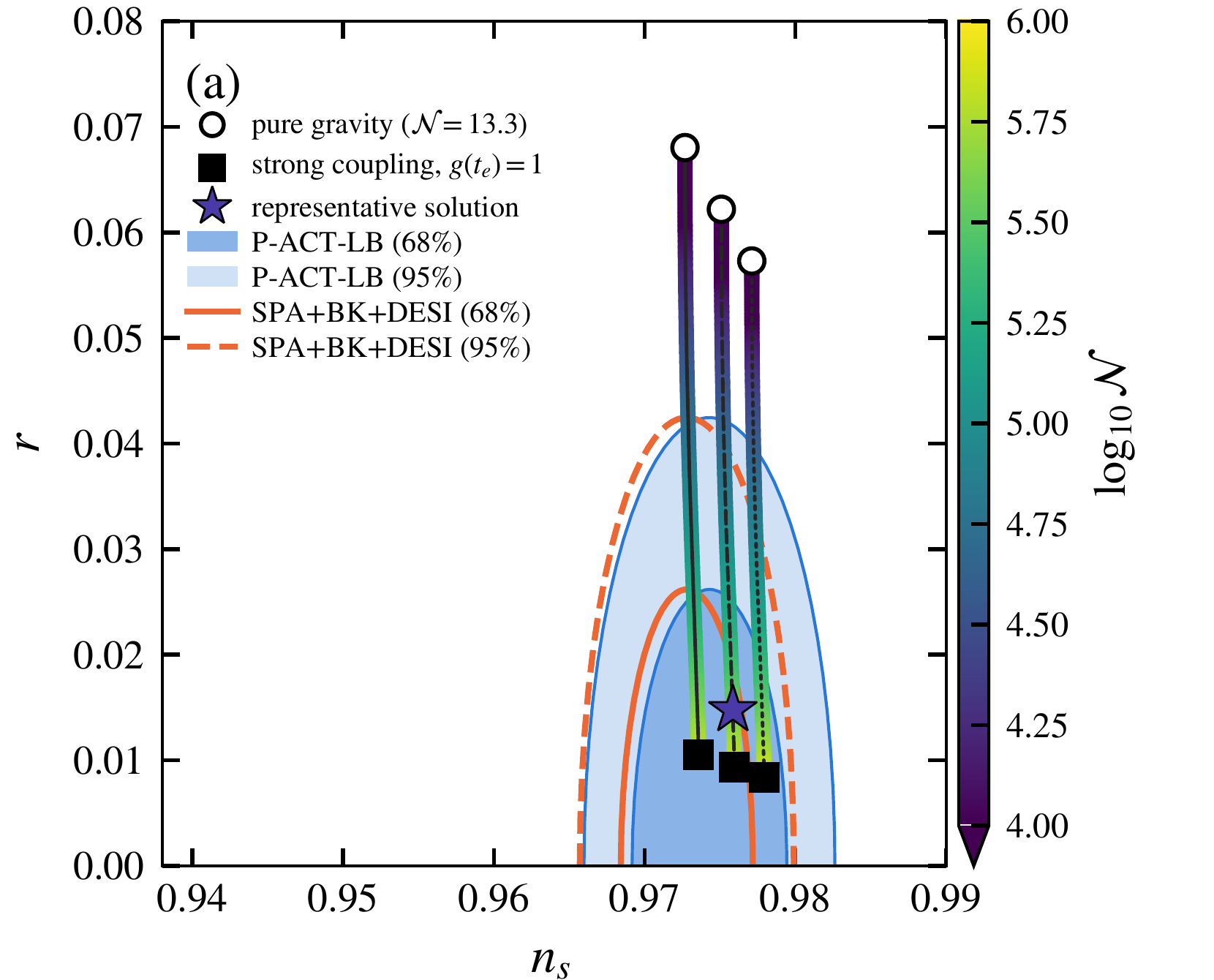
Current limits already rule out the pure-gravity version of this scenario. To bring the predicted tensor signal below the present bound, the calculation needs a very large matter sector. We do not know whether nature provides such a sector. The model also leaves reheating, the emergence of ordinary Einstein gravity after inflation, and the interpretation of an extra spin-2 mode to be resolved.
That is why I see this result as progress on a specific theoretical problem, not a complete account of cosmic origins. Keeping a term that looked dispensable restores a consistent candidate starting point. Better measurements of CMB polarization can now test a consequential part of the picture.
The point of giving inflation a beginning is to make its proposed history more accountable to the sky.