When two black holes merge, the remnant rings like a struck bell, and that ringing is how we test whether it is the black hole Einstein's theory predicts. Jahed Abedi and I asked what the horizon itself allows during the first moments of that ringing. The answer changes which tones we should expect to hear, and when.

The bell picture
Strike a bell and it rings at its own pitches. They are set by its shape and material, not by the hammer. A black hole formed in a merger does something similar. In the last part of the gravitational-wave signal it rings at its quasinormal modes: damped tones whose frequencies and decay rates depend only on its mass and spin. Measure two or more of them, check that they point to the same mass and spin, and you have tested the Kerr solution of general relativity. This is black-hole spectroscopy.
The longest-lived tone is the fundamental mode. Its overtones die away faster. Because the signal is loudest near its peak, many analyses fit the fundamental mode together with overtones starting close to the moment of merger.
But a bell rings at its own pitches only after the hammer has left it. While the hammer is still in contact, what you hear is partly the hammer.
What the horizon allows
Quasinormal modes are defined by a boundary condition: at the horizon, keep only waves that fall in. We asked a simple question about the waves this condition throws away. What does a regular horizon, one that an infalling observer crosses without noticing anything special, require of them?
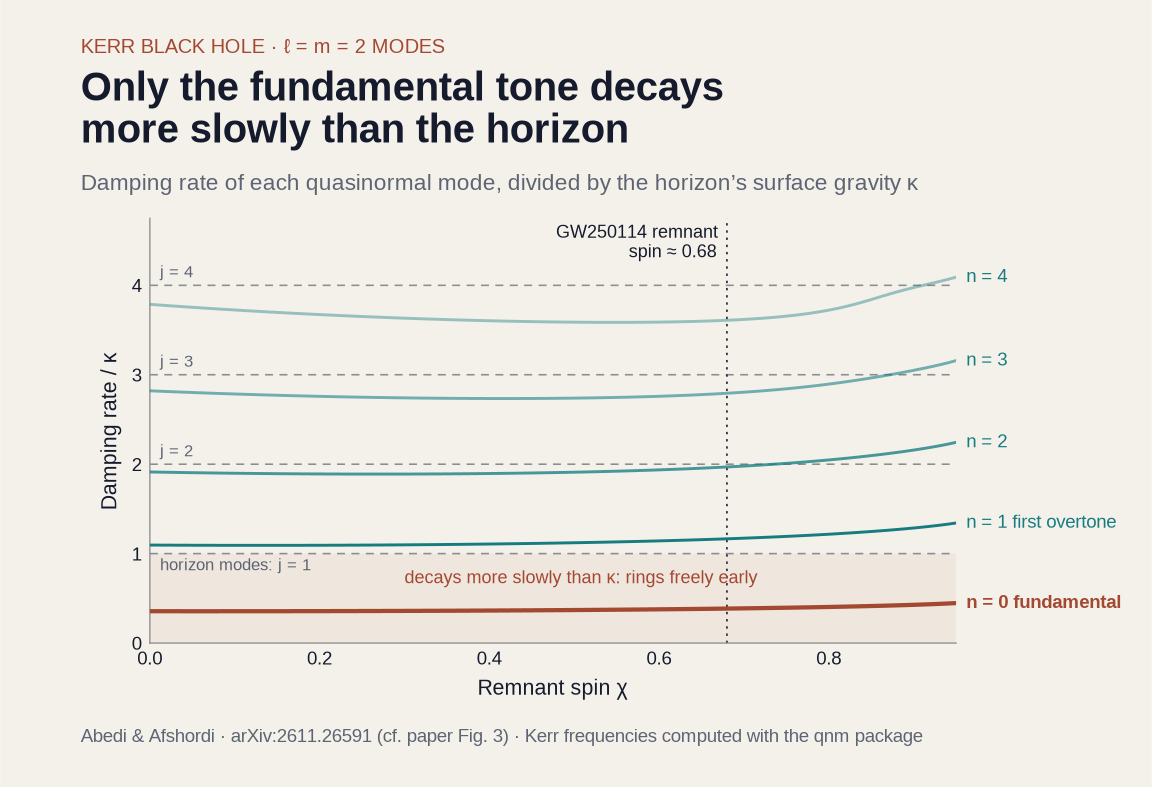
For a scalar-like perturbation, asking for bounded derivatives in a frame that is regular at the future horizon rules out outgoing waves that decay more slowly than the surface gravity, κ, the horizon's own natural rate. Asking for smoothness then picks out a ladder of frequencies,
ω = mΩH − i j κ, j = 1, 2, …
where ΩH is the angular velocity of the horizon. We call these the horizon modes.
None of this changes the quasinormal-mode spectrum. It matters for the transient. During a merger, the source is still falling through the horizon, and it drives the outside at the horizon frequencies. Each quasinormal mode then has two parts: a driven part that follows the source, and a free part, the bell's own ringing. The free part takes over only once the driving decays faster than the mode itself.
Here the ordering matters. For a Schwarzschild black hole, and for the dominant ℓ = m = 2 modes of a spinning Kerr black hole, only the fundamental mode decays more slowly than κ. So the fundamental mode separates from the driving early. The overtones decay faster and stay driven until the source is hidden behind the potential barrier that surrounds the black hole. In general, then, overtone amplitudes fitted near the peak of the signal are not the amplitudes of free oscillations.
A test on GW250114
GW250114 is an exceptionally loud binary black-hole merger, observed in January 2025, and loud enough to fit its ringdown with more than one mode. We compared two ringdown models:
1. the fundamental mode plus its first overtone;
2. the fundamental mode plus the first horizon mode, ω = 2ΩH − iκ.
For start times from 2Mf before to 8Mf after coalescence, where Mf is the mass of the final black hole in geometric units, the data prefer the second model, with Bayes factors between 2 and 30.
The horizon-mode fit also returns a remnant that is heavier and spins faster than the inspiral predicts. That is what we would expect from nonlinear backreaction: the horizon that emits this mode has not yet settled to its final mass and spin.
Still general relativity
Is this a hint of new physics? No. We injected waveforms calibrated to numerical relativity, that is, ordinary general relativity, into simulated data without noise, and analysed them in the same way. They reproduce both the preference for the horizon mode and the shift in mass and spin. Both are features of how general relativity rings down. What changes is the bookkeeping: which part of the early signal is the bell, and which part is still the hammer.
What this does and does not say
It is not a new detection, and it does not point to exotic structure at the horizon. The horizon modes follow from asking an ordinary horizon to be regular.
The horizon statements are local and are derived for scalar-like perturbations. The comparison on GW250114 is between these two specific two-mode models, over the start times quoted above.
What it does say is practical. When overtones are fitted near the peak of a merger signal, their amplitudes should not be read as those of free oscillations. Analyses that rely on early overtones need to account for the driven transient. That matters more as detectors improve and more mergers become loud enough for spectroscopy. The data and analysis scripts are public, so anyone can rerun the comparison. The preprint, written with Jahed Abedi, is arXiv:2611.26591; the data and scripts are at github.com/jahedabedi/horizon-mode-ringdown-GW250114.