Loop quantum cosmology replaces the big bang with a bounce, but only inside a simplified model. Kristina Giesel and I asked whether that bounce can be written as a local, generally covariant theory without adding a new wave to the universe. It can, using a field whose only job is to enforce a rule.
Run an ordinary expanding cosmological solution backward and the universe grows denser without limit, until the equations stop making sense. That breakdown, the big bang singularity, is less a description of the beginning than an admission that the theory has run out of road.
Loop quantum cosmology, or LQC, offers one way past it. It applies quantum-gravity ideas to a deliberately simplified universe: perfectly smooth, the same in every direction, spatially flat. In that setting the familiar Friedmann equation, which ties the expansion rate H to the density ρ, picks up a correction:
H 2 = ρ(1 − ρ/ρ c)/(3M Pl 2)
At ordinary densities the correction is negligible. As ρ approaches a finite critical density ρ c, the right-hand side shrinks to zero, and so does H. Contraction halts, and expansion begins. There is a bounce instead of a singularity.
An equation is not yet a theory
This equation lives only in the simplified model. To ask how ripples, lumps or gravitational waves behave near the bounce, you want an action: a rule for spacetime that is local, can be written independently of a choice of coordinates (general covariance), and applies everywhere, not only to a perfectly smooth universe.
That turns out to be hard. Lovelock's theorem leaves essentially Einstein gravity, with a possible cosmological constant, if we demand a local, metric-only theory with second-order equations in four dimensions. The usual way out is to add a new field. New fields, however, usually bring new waves and new particles. Earlier covariant reconstructions of the LQC bounce paid other prices. Some relied on functions obtained numerically or by fitting. Others removed the unwanted modes only perturbatively.
A field that only enforces
The tool we used is the cuscuton, a field that my colleagues and I proposed in 2006. Its kinetic term is a square root rather than the usual square. As a result, its equation of motion is not a wave equation at all. It is a constraint, a condition that the geometry of space must satisfy at each moment. Formally, its perturbations have an infinite speed of sound. That is a way of saying there is no wave to propagate. It does not mean signals can be sent instantaneously. In short, the cuscuton adds no extra locally propagating scalar.
The key step was noticing that LQC already contains the right variable. In LQC, gravity enters through a compact angle, the polymerization angle θ. In terms of that angle, the density is ρ c sin2(θ/2) and the expansion rate is proportional to sin θ. So we made θ the cuscuton field and gave its square-root term an angle-dependent tension.
The pieces then fall into place. The cuscuton's constraint sets H proportional to sin θ. The field carries a negative energy density, which supplies exactly the −ρ 2/ρ c term. Einstein's equation then forces ρ = ρ c sin2(θ/2). Combined, these reproduce the LQC equation exactly, in closed form, with the bounce at θ = π. No particular kind of matter has to be chosen. The result holds for any minimally coupled, conserved matter with ρ + p > 0 on the regular branch. Trajectories that violate the null energy condition fall outside it.
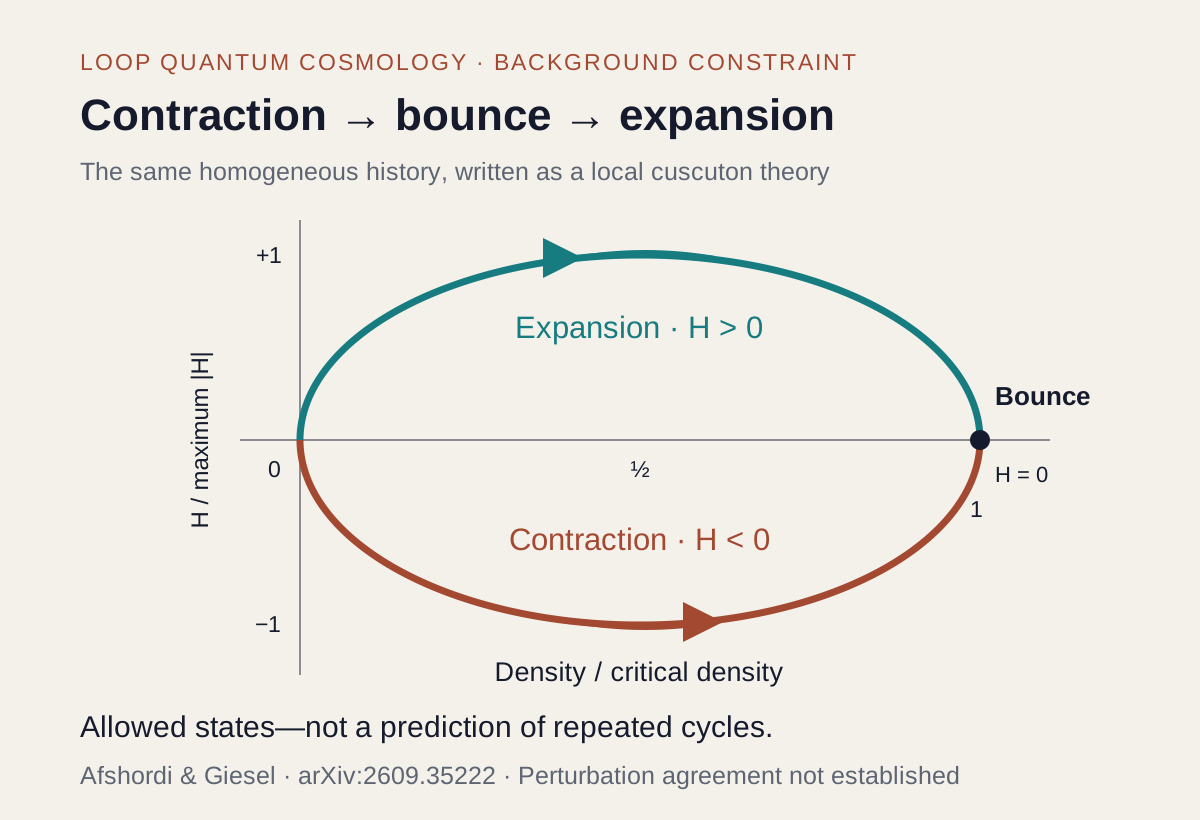
Same bounce, different universes
We are not the only ones to reach this ellipse. Limiting-curvature mimetic gravity, which builds on a constrained clock field, reproduces the same flat-universe bounce. We found an exact bridge between the two approaches. A branchwise Legendre transformation maps the homogeneous mimetic system, with its clock fixed and its dust-like energy set to zero, onto our cuscuton. That bridge also explains where the cuscuton's odd-looking angular factors come from.
The bridge ends at the smooth background. In a lumpy universe the two theories differ. Mimetic gravity carries an extra dust-like scalar, with zero sound speed in its minimal form and a negative squared sound speed in the version that reproduces LQC. The cuscuton carries no such mode. The lesson is that two theories can agree perfectly on how the whole universe expands and still disagree about the dynamics of the ripples on top of it.
What remains open
That lesson also limits our own result. Matching the background does not match perturbations, anisotropy or full loop quantum gravity. We have not yet computed perturbations for this particular action, and stability results for other cuscuton bounce models cannot stand in for that calculation. Anisotropic LQC generally modifies more than the mean curvature our construction tracks, so agreement there is not guaranteed. Our construction is an effective representation of the LQC holonomy correction. It is not derived from full quantum gravity, and it is not evidence that our universe actually bounced.
So why build it? Within effective LQC, several established methods of handling cosmic ripples share the same bounce but disagree about the ripples themselves. A specified covariant action removes that freedom at the classical level: expand it around a chosen bounce background, and its perturbation equations follow. Our angular cuscuton is now a definite candidate for that test. Agreement with a particular LQC perturbation prescription would extend the bridge beyond the smooth background. Disagreement would show where a field that never waves stops being enough. Either outcome is useful. The preprint, written with Kristina Giesel, is arXiv:2609.35222. The original cuscuton paper is arXiv:hep-th/0609150.