DESI's map of cosmic distances is usually read as a hint that dark energy changes over time. In a new preprint, we test a leaner possibility: that the gravity steering cosmic expansion is slightly weaker than the gravity we measure up close.
Physicists treat Newton's gravitational constant, G, as one of the fixed points of the world. We measure it in laboratory experiments and test its consequences with the motions of planets and pulsars. Then, almost without noticing, we carry that same number across an enormous leap in scale and put it into the equation that governs how the entire Universe expands.
Laboratory measurements do not by themselves establish that step. It is an assumption, and a natural one. But it is still an assumption. In a new preprint with Robin Wen, Lukas Hergt and Douglas Scott, we ask whether the latest cosmological data are quietly telling us that it is slightly off.
An anomaly with a default story
The Dark Energy Spectroscopic Instrument (DESI) measures baryon acoustic oscillations (BAO). These are a ripple frozen into the distribution of galaxies, which serves as a cosmic ruler. Combined with the cosmic microwave background (CMB), the oldest light in the sky, DESI's data show a mild but persistent preference for departures from the standard cosmological model, ΛCDM.
The usual reading is that dark energy evolves. The standard version adds two parameters, w 0 and w a, which describe how dark energy's behaviour changes over cosmic time. That is a useful description. It is not a theory, because it says nothing about what physical mechanism would set those two parameters.
So we asked a simpler question. Are the data really asking for two new parameters, or for a single physical mismatch?
One parameter
The cosmic-glitch model allows two gravitational constants that are usually assumed equal to differ:
- G N, the Newtonian constant measured locally;
- G cosmo, the constant that sets how the homogeneous Universe expands.
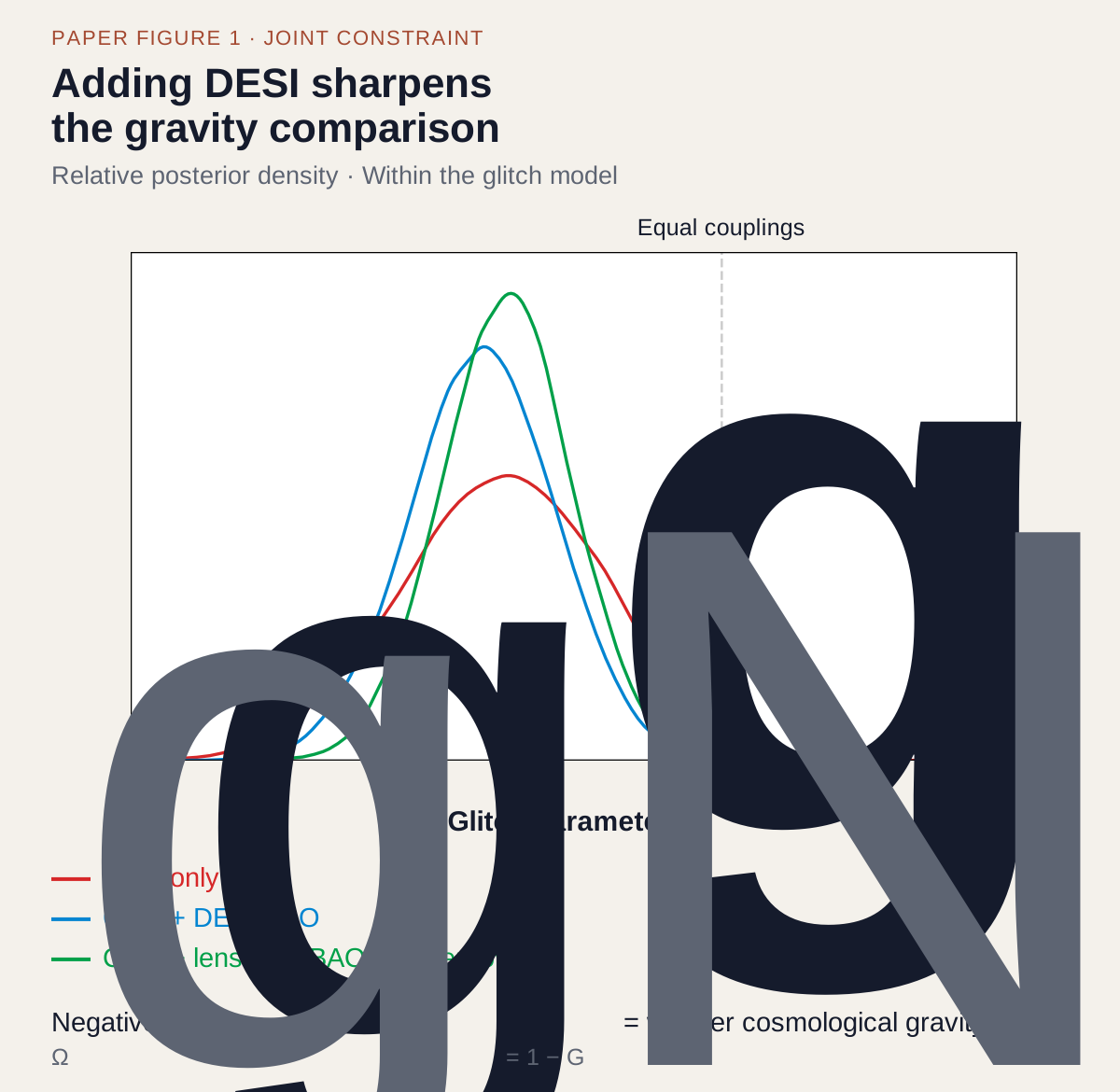
A single parameter captures the mismatch: Ωg = 1 − G N/G cosmo. When Ωg is zero, we recover standard cosmology. When it is negative, the Universe as a whole gravitates a little more weakly than a solar system does.
This is not an arbitrary tweak. A mismatch of exactly this kind is a generic low-energy feature of gravity theories with a preferred slicing of time, including Hořava–Lifshitz gravity, Einstein-aether theory and the cuscuton. In the nearly incompressible Hořava/cuscuton limit discussed in the paper, a cosmic glitch remains a cosmological target even when local tests are satisfied.
A prediction held out of the fit
The most persuasive test is not a joint fit. A flexible model can fit a trend without tightly predicting it from an independent data set.
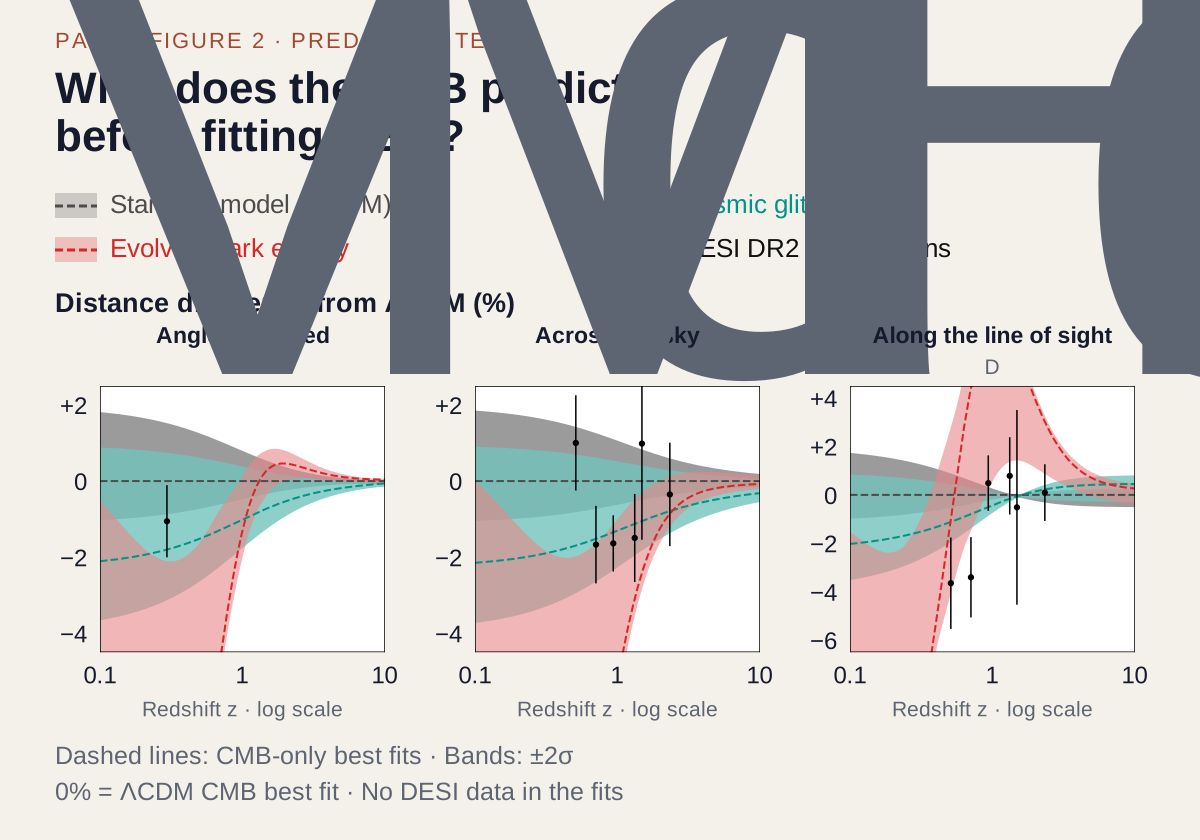
Instead, we fit each model to the CMB alone, combining data from Planck, ACT and SPT, with no DESI data entering the fits. We then ask what each fitted model implies for DESI's distances. These distances are measured relative to the sound horizon, the size of the cosmic ruler.
- ΛCDM: fitted to the CMB, its predictions sit above DESI's angle-averaged and transverse points below a redshift of about one.
- The glitch: fitted to the same CMB data, it predicts a downward shift of 1–2% in exactly those distance ratios. Its band is about as narrow as the ΛCDM band and passes through the DESI points.
- Evolving dark energy: fitted to the CMB alone, its band spans several percent in either direction. The CMB by itself cannot pin down its two parameters.
The broad band does not mean evolving dark energy fails once DESI is included; in a joint fit, it does well. It means the glitch makes the sharper commitment.
This is a held-out comparison: DESI is kept out of the fit. It is not a forecast published before the data arrived.
The number
When the primary CMB data are combined with DESI's latest BAO release, we find
G cosmo/G N = 0.9920 ± 0.0025.
In other words, the gravity governing cosmic expansion comes out about 0.8% weaker than local gravity. That is a nominal 3.3σ preference within this model and this analysis.
The CMB alone already leans in this direction, at about 2σ. DESI tightens the constraint without moving its centre. Adding CMB lensing and DES supernovae gives 0.9928 ± 0.0022, still at a nominal 3.3σ.
What this does not settle
A 3.3σ preference within one model is not a probability that the model is true, and it is not a discovery.
Comparing the competing explanations requires a different calculation: Bayesian evidence. For computational reasons, we computed it with the foreground-marginalized SPA lite CMB likelihood, rather than the Hillik likelihood used for the main fit. Relative to ΛCDM, the differences in log-evidence under our adopted priors are:
- CMB plus DESI: both the glitch and evolving dark energy score about +3.2. That is a tie, so the second parameter buys nothing extra.
- Adding lensing and supernovae: the glitch drops to +1.1 and evolving dark energy to +2.2. That mildly favours evolving dark energy, whose extra freedom can accommodate the higher matter density that supernovae prefer.
Neither result is a decisive verdict, and both depend on the choice of priors.
The theory also has an open seam. We model how fluctuations evolve with an effective prescription. When we vary the assumed sound speed of those fluctuations, the preference for weaker cosmological gravity survives, staying at or above 2.8σ. Its numerical value shifts, however: in the high-sound-speed regime the physical theories point to, Ωg is closer to −0.006.
A first-principles treatment of finite-speed perturbations, derived from an underlying gravitational theory, is still to be done. This result is not a detection of Hořava gravity as a complete theory, and it is not evidence that every modified-gravity idea is favoured.
How it could fail
The glitch is testable precisely because its two constants play different roles. Expansion follows G cosmo, while the pull of matter on matter still follows G N. As a result, cosmic structure grows slightly faster than in ΛCDM. The model predicts that:
- the late-time clustering amplitude should exceed the ΛCDM extrapolation from the CMB by a few percent;
- the clustering combination fσ8, measured through redshift-space distortions, should show a nearly constant offset of about 3% between redshifts 0.3 and 1.5;
- gravitational lensing and galaxy motions should respond in lockstep;
- slowly evolving gravitational potentials should leave a mark in correlations between the CMB and galaxies.
These checks have to be carried out within the glitch model itself, rather than by borrowing parameters inferred under ΛCDM. DESI, Euclid, Rubin, ACT, SPT and the Simons Observatory can all sharpen the test.
What makes this result interesting to me is not the significance alone, but the economy. One number, calibrated on the oldest light in the Universe, lands where DESI's galaxies sit. That agreement may still dissolve under better data or a fuller theory. Even so, the DESI-era anomaly need not be read first as evidence of evolving dark energy. A single, physically motivated glitch in gravity deserves to be tested alongside evolving dark energy, not after it, and structure-growth measurements are where it will stand or fall.