A survey found deep disagreement at the frontiers of physics. Brian Keating saw intellectual denominations. My co-author Phil Halper objected. Adam Frank defended the health of science. I found myself somewhere between them.
When Brian Keating asked whether physicists have faith in their theories, I found myself torn.
Part of me resisted the word. Science is not supposed to rest on faith. It earns its authority by allowing observations to defeat even our most cherished ideas.
But another part of me recognized the uncomfortable truth behind Brian's question. Physicists are human. We choose problems before the evidence is decisive. We inherit assumptions from our teachers, become attached to elegant theories, and sometimes spend decades defending ideas that nature has not yet agreed to test.
This is not an abstract tension for me. The first half of my life was lived under an Islamic theocracy, where religion was invoked to govern almost every part of public and private life. The second half has been driven by science: I left Iran to pursue the deepest and darkest mysteries of the cosmos.
As Phil Halper and I asked in Chapter 11 of Battle of the Big Bang: you can take the cosmologist out of religion, but can you take religion out of the cosmologist?
Our Big Mysteries Survey, written with Phil, Matteo Rini, and Michael Schirber, has brought me back to that question in a new way.
The survey that started the argument
The survey asked physicists about ten unresolved questions in cosmology, black-hole physics, quantum mechanics, quantum gravity, and anthropic reasoning. It received 1,675 responses from readers of the American Physical Society's Physics Magazine and APS members.
This was an open online survey, not a random sample of every physicist. It should be read as a large snapshot of a broad and heterogeneous community, not as an electoral poll with a precise margin of error.
Even with that caveat, the disagreement was striking. Several positions often presented publicly as established consensus received only narrow majorities or pluralities. On questions such as inflation, the black-hole information problem, interpretations of quantum mechanics, and quantum gravity, physicists were far from united.
Only one answer across the survey passed the two-thirds mark. About 68 percent said that the Big Bang means the universe evolved from a hot, dense state, without telling us whether time had an absolute beginning.
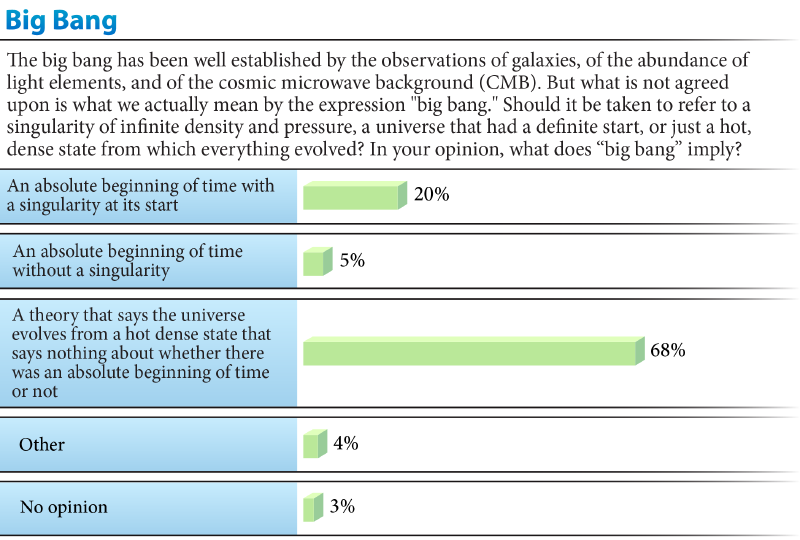
That result struck me as almost poetic. The strongest consensus in the survey was not a grand claim about ultimate origins. It was a boundary around what the evidence allows us to say.
But there was another result. The answers were not statistically independent. Certain positions tended to travel together. Respondents who preferred one kind of explanation on one question were more likely to favor related explanations elsewhere.
Brian looked at those patterns and saw something worrying.
Brian's challenge: intellectual denominations
Brian argued that when evidence runs thin, theoretical commitments can begin to resemble faith. Ideas gather into worldviews. Mathematical beauty, authority, professional prestige, and community loyalty can carry more weight than observation.
He called these clusters "intellectual denominations."
The phrase is provocative, but the concern behind it is real. Some parts of fundamental physics have remained beyond decisive experimental reach for decades. In such fields, a research program can become self-reinforcing. Students are trained inside a framework. Successful practitioners hire the next generation. Technical sophistication accumulates, and the existence of an impressive cathedral of ideas can begin to look like evidence that the cathedral describes nature.
I have seen enough of theoretical physics to know that groupthink exists. There is no need to imagine a conspiracy. Ordinary human dynamics are enough.
Popularity, however, is not the same as scientific consensus. A popular theory may be popular because it is genuinely powerful, because it has solved hard problems, and because its alternatives are weaker. Or it may benefit from history, institutions, and intellectual fashion. Usually, the truth contains some mixture of these explanations.
Brian is right to ask whether we sometimes present speculative prestige as empirical success.
But a survey of correlations cannot answer that question by itself.
Phil's objection: a pattern is not its cause
My co-author Phil offered a forceful response to Brian's interpretation. His central methodological objection is the strongest one: the survey shows that views cluster, but it does not tell us why.
Correlated answers could arise because the underlying theories are logically connected. They could reflect shared assumptions, common training, specialization, professional networks, or philosophical outlooks. They might also reflect institutional sociology, motivated reasoning, or group identity.
These explanations are not mutually exclusive.
A theoretically coherent program can also become socially self-reinforcing. A community can have good reasons for concentrating on one framework and still become less receptive to alternatives. Conversely, the existence of a visible research community does not prove that its members are irrational, tribal, or religious.
Statistical significance tells us that a pattern is unlikely to be a random fluctuation in this sample. It does not turn the pattern into a psychological diagnosis.
Phil is therefore right that our data do not establish a "faith problem" in physics. I would be uncomfortable using the survey to infer the motives of thousands of respondents whom we never asked why they chose their answers.
But I also do not want causal caution to become an excuse for ignoring the sociology of science. Physicists are not freed from ordinary human behavior by learning tensor calculus.
Adam's defense: most of physics is working
When I joined Brian and astrophysicist Adam Frank for our conversation about God, aliens, string theory, and the limits of science, Adam pushed back from another direction.
He argued that the concerns Brian raised apply most strongly to a relatively small part of physics where decisive data are scarce. They should not become an indictment of physics as a whole.
Much of physics remains in close contact with experiment and observation. Quantum information, condensed matter, astrophysics, cosmology, complexity, and exoplanet science are producing remarkable discoveries. In these fields, Adam said, a theory can still "get its butt kicked by new data."
He also questioned whether the mysteries in our survey, many inherited from twentieth-century fundamental physics, will remain the central questions of the twenty-first. For Adam, life, agency, information, and complexity may point toward a very different scientific frontier.
That is a fair challenge. A survey reveals not only answers but also what its authors chose to ask. Phil, Matteo, Michael, and I selected questions that have preoccupied cosmology and fundamental physics for decades. Other physicists may reasonably believe that the most transformative questions now lie elsewhere.
Adam's warning matters: a problem in one corner of physics should not be inflated into a story that science has stalled or become a religion.
Yet his defense and Brian's criticism can both be true. Physics can be extraordinarily healthy overall while some of its most visible speculative programs struggle with empirical accountability.
 Brian Keating Podcast3 Physicists on God: Aliens, String Theory, and the Limits of Science ↗Brian Keating with Adam Frank and Niayesh Afshordi
 SkydivephilIs There a Faith Problem in Physics? A Response to Brian Keating ↗Phil Halper examines what the survey can and cannot establish
The chapter behind the debate
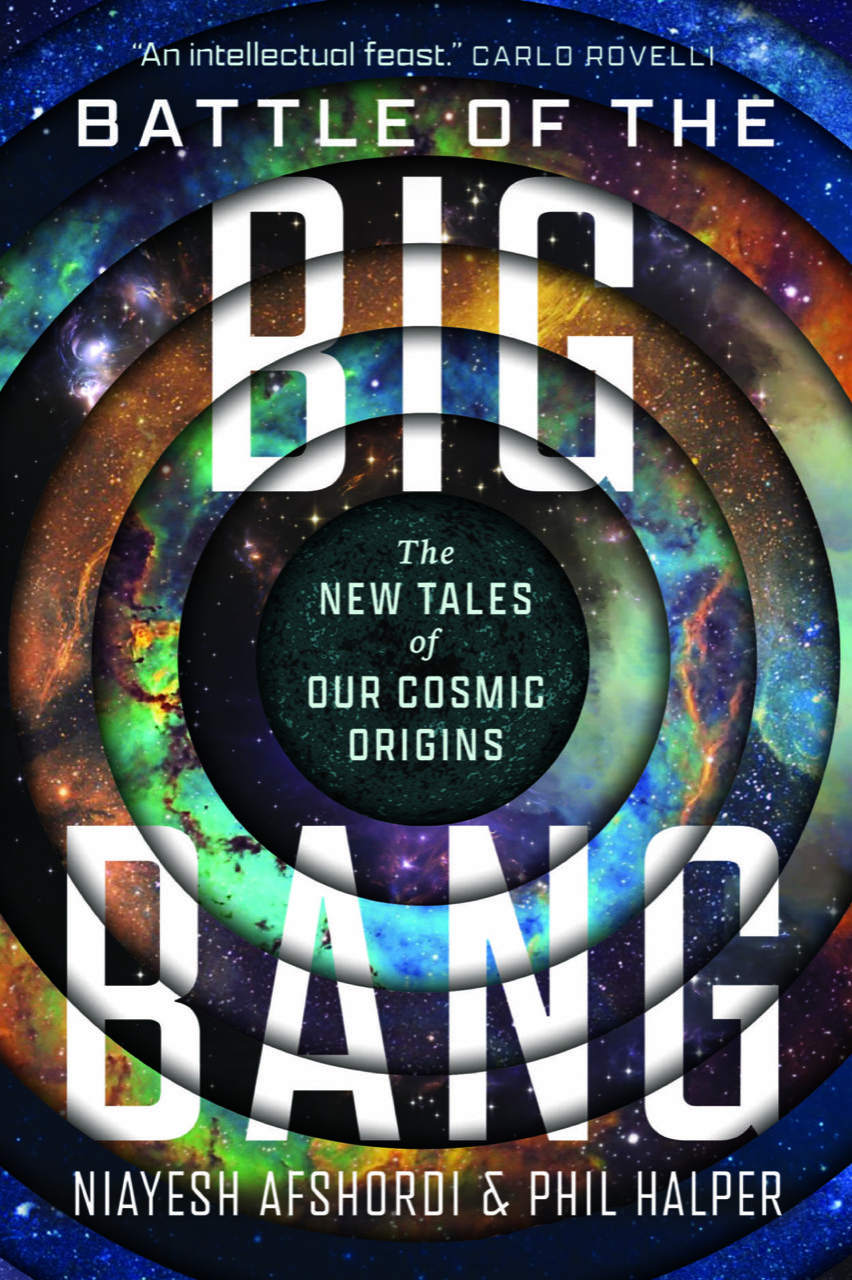
Long before this exchange, Phil and I wrestled with the same tension in Chapter 11 of Battle of the Big Bang, "Science of Religion, Religion of Science."
Even then, Phil and I did not stand in exactly the same place. I worried that physicists who challenge fashionable assumptions can be pushed into the professional wilderness. Phil pointed out that the rebels he interviewed for the book were publishing papers and holding good academic jobs. He thought I was too pessimistic; I wondered whether he was seeing the survivors. That difference between us has not disappeared. His critique protects our survey from overinterpretation. My instinct still tells me that the human dynamics Brian worries about are real.
After presenting more than a dozen competing accounts of what may have happened at the Big Bang, we refused to declare a winner. At the frontier, certainty is seductive but often misplaced. We proposed amending the familiar slogan "follow the science" to something more honest:
Follow the science and embrace uncertainty.
That does not mean every claim is equally plausible. We can compare explanations. We can count assumptions. We can demand consistency with established knowledge and calculate consequences for observations. We can ask whether an idea explains a lot while assuming little.
But outside the domain where data compel convergence, judgment becomes unavoidable. Elegance, simplicity, explanatory power, and intuition help us decide which paths to explore. They do not by themselves establish which path nature has taken.
This is why Chapter 11 turns from the old battle between science and pseudoscience to a subtler category: proto-science.
Proto-science needs room to breathe
New theories do not arrive fully grown. They begin as conjectures supported by incomplete evidence. Richard Feynman described science as "imagination in a tight straitjacket" - the straitjacket being existing knowledge and data.
That image captures proto-science beautifully. Imagination is essential. Without it, there is no path beyond what we already know. But the constraints are equally essential. Without them, anything goes.
In our conversation, I compared a young theory to a child. At first it needs advocates willing to nurture it, work out its consequences, and help it survive early difficulties. But eventually it has to grow up. We cannot keep feeding and protecting it forever. It must make its own way in the world of evidence.
I now find it useful to distinguish three attitudes toward an unconfirmed idea.
An explorer treats a framework as a promising possibility. An explorer may devote years to it while remaining clear about what is known, what is assumed, and what could count against it.
A believer assigns substantial confidence despite incomplete evidence. That is not automatically irrational. Frontier science would be impossible if nobody committed time and energy to an idea before it was established. As we wrote in the book, until the data have spoken, it is better to be an explorer than a believer - but explorers still need conviction to continue the journey.
A dogmatist makes the framework increasingly immune to failure. Uncertainty is obscured. Criticism is treated as disloyalty. Each disappointing result is met by another adjustment that leaves confidence untouched.
The decisive boundary is not simply between evidence and belief. It is between transparent, provisional commitment and misrepresented certainty.
A speculative scientific program need not already be experimentally confirmed. It should, however, be constrained by what we know, developed toward empirical contact, and remain vulnerable to displacement.
The problem is not speculation. The problem is speculation presented as fact.
Priors are unavoidable. Vulnerability is a choice.
During the conversation, I described scientific beliefs in Bayesian terms. Before seeing new evidence, we have priors: judgments about which models are plausible. We then combine those priors with data to reach updated conclusions.
Brian pressed me on the terminology. Is a "prior" simply a more respectable word for faith?
The question stayed with me.
We cannot reason without starting assumptions. A scientist comparing theories must consider existing evidence, mathematical consistency, explanatory reach, and compatibility with other knowledge. But technical language can also conceal subjective commitments. Two physicists may look at the same ambiguous evidence and reach different conclusions because they began in very different places.
The answer is not to pretend that priors do not exist. It is to make them vulnerable.
When evidence becomes sufficiently strong, observers who began with different reasonable priors should converge. That is what happened with the hot, dense phase of the Big Bang. It has not happened for an absolute beginning of time, a particular theory of quantum gravity, or a single interpretation of quantum mechanics.
Where nature has not forced convergence, honest disagreement is not a failure of science. Misrepresenting that disagreement as certainty is.
Where I land
Brian, Adam, and Phil are guarding against three different mistakes.
Brian warns us not to confuse intellectual prestige with empirical evidence.
Phil warns us not to confuse correlation with causation, or disagreement with religious faith.
Adam warns us not to confuse the empirical difficulties of a speculative subfield with the health of physics as a whole.
I think we need all three warnings.
The survey does not prove that physicists belong to intellectual religions. But it does reveal a community more fragmented than the public language of consensus often suggests. It shows that our views have structure. It gives us a reason to ask where that structure comes from - through better surveys, interviews, comparisons across fields and generations, and, most importantly, questions about what evidence would change people's minds.
That is the research program I would now like to see. Do theoretically connected answers cluster more strongly than unrelated ones? How much do advisor lineages, career stages, or subfields matter? Are scientists equally demanding of evidence for theories they favor and theories they dislike? What happens to these clusters after a genuinely decisive observation?
These are better questions than asking whether string theorists, cosmologists, or anyone else are secretly religious. They turn a rhetorical accusation into an investigation of how knowledge is made.
Let nature have the final word
I began the Big Mysteries project wanting to measure what physicists think. I came away wondering how often we tell ourselves, our students, and the public what we actually know.
My personal history makes me wary of dogma, but it has also taught me that declaring oneself free of faith does not make one free of human instincts. Scientists form communities. We inherit assumptions. We admire beautiful ideas. We sometimes mistake familiarity for truth.
Science works not because scientists are uniquely rational, but because we have built a public method through which fallible people can correct one another. Claims can be criticized, calculations checked, observations repeated, and cherished ideas defeated.
At least, that is science at its best.
I still resist calling science a faith. Scientific commitment is conditional in a way religious faith need not be. But Brian's question has made me less interested in defending the purity of the word "science" and more interested in defending the habits that make science worthy of trust.
Humility is one of those habits. So is openness. So is saying "we do not know" when the evidence runs out.
The strongest agreement in our survey was that the Big Bang does not tell us whether time had an absolute beginning. Perhaps that is an appropriate lesson for the rest of physics as well.
The frontier is not where certainty lives. It is where we learn to explore without pretending we have already arrived.
And when nature finally speaks clearly, we must be willing to let it have the last word.